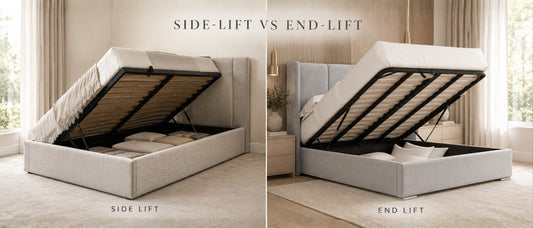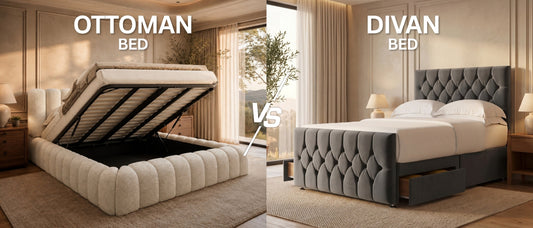
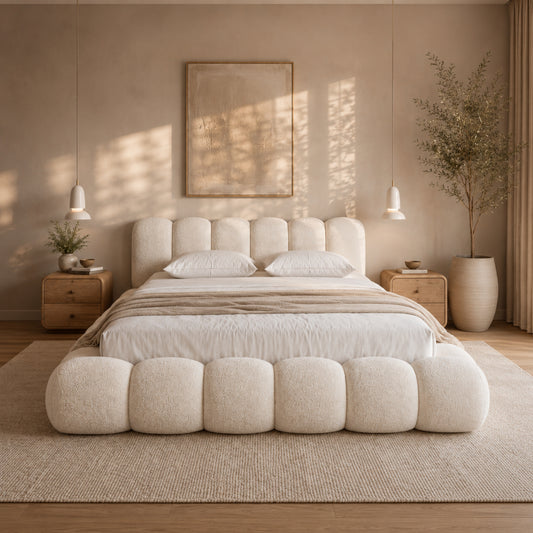
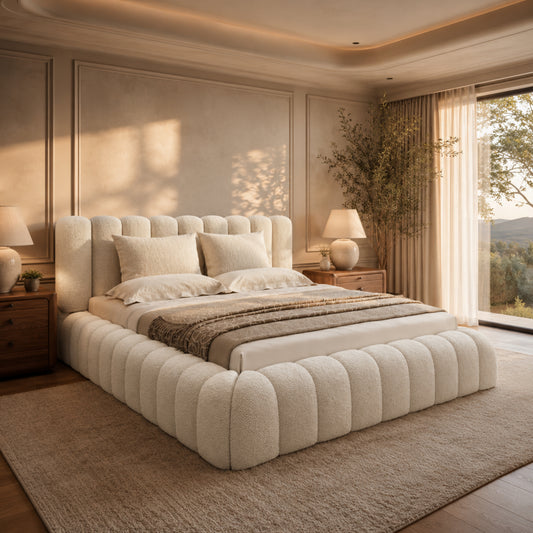




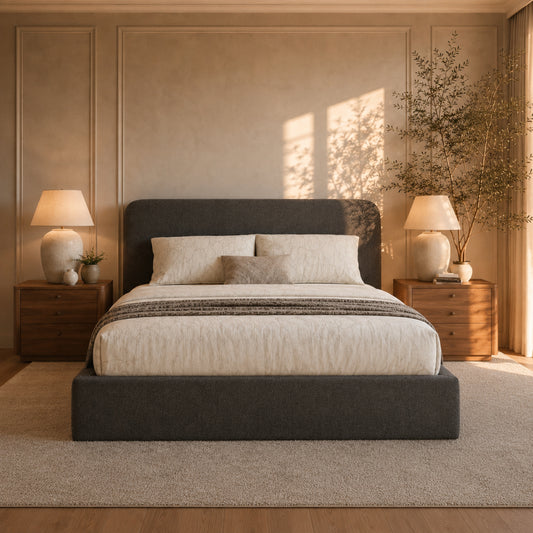



Choose an ottoman bed if you want to store big, awkward things you only need now and then, like suitcases, spare duvets and winter coats. Choose a divan bed with drawers if you want quick access to smaller things you use every week, and you have floor space beside the bed for the drawers to open.
Both hide clutter and both come in upholstered styles, so neither is the "wrong" choice. They just suit different rooms and different habits. This guide compares them properly and ends with a short test to help you decide.

The Quick Comparison
| Ottoman bed | Divan bed with drawers | |
|---|---|---|
| How the storage works | The whole base lifts on gas struts | Drawers slide out of the base |
| Storage space | The full area under the mattress | Split into two or four drawers |
| Best for | Bulky, occasional items | Small items you reach for often |
| Space needed | Room above and at the lifting end | Floor space beside the bed |
| Access while someone's in bed | No | Yes |
| Moving parts | Gas struts and hinges | Drawer runners |
| Typical price | Usually higher | Usually lower |
If you only remember one thing: an ottoman gives you more storage in less floor space, while a divan gives you quick everyday storage at a lower price.
What is a Divan Bed?
A divan is a solid upholstered base that the mattress sits directly on, usually with a headboard fixed to it. Instead of slats and legs with open space underneath, the base is a closed box. That box is where the drawers go.

Most divans have two or four drawers. Four drawers usually means two on each side. Two drawers can mean both on one side, or one at each end. It's worth checking the layout on any bed you're looking at, because a drawer that opens towards a wardrobe or wall is a drawer you'll never use.
You can browse our divan beds here.
What is an Ottoman Bed?
An ottoman bed has a base that lifts up on a pair of gas struts, like the boot of a car. Underneath is one open storage well that covers roughly the whole footprint of the bed. The mattress stays on the platform while you lift it, and the struts take most of the weight.

If you're new to them, our guide to what an ottoman bed is and how it works covers the basics. You can see the full range in our ottoman beds collection.
Storage: How Much Space and What Fits
This is where the two differ most.
A divan's storage is split up. Each drawer is shallow, and there's a structural frame between the drawers. That's fine for folded T-shirts, spare sheets, shoes and the charger cables that live nowhere else. It's no good for a suitcase or a king-size winter duvet, which simply won't fit through a drawer front.
An ottoman gives you one big space. You can lay a suitcase flat, stack vacuum bags of bedding, or keep a box of Christmas decorations out of sight for eleven months of the year. If you don't have a loft, or your wardrobes are already full, this is the reason people choose an ottoman.
The downside is that one big space can turn into one big heap. Soft storage bags or a couple of fabric boxes keep it usable.
How Often You Need Your Things
This question gets overlooked, but it decides a lot.
With a divan, getting to your things takes a second. You pull a drawer open, grab what you need and push it shut. You can do that while your partner is still asleep, and you don't have to touch the bedding.

With an ottoman, you lift the whole platform. The gas struts make that easy, but it's still a small job, and you can't do it with someone in the bed.
So think about what you'll actually store. If it's things you reach for most days, a divan is more convenient. If it's things you need a few times a year, the ottoman's extra space matters far more than the extra step.
Which Needs More Room?
Both need clearance, just in different places.
A divan needs floor space where the drawers open. A drawer that's 40 cm deep needs about that much clear floor in front of it, plus room for you to stand. In a narrow room where the bed runs close to a wall or wardrobe, those drawers can end up half-usable or blocked altogether.
An ottoman needs space above the bed, and room to stand at the end or side where it lifts. Watch out for low sloping ceilings in loft rooms, and for shelves or wall lights above the headboard. On the other hand, it can sit tight against walls on both sides, which is why ottomans suit box rooms so well.
Before you order either, mark the bed's full size on the floor with masking tape. Then open your wardrobe and walk around it. Our guide on how to measure your bedroom for a bed goes through it step by step.
Cost and Long-Term Upkeep
Divans are usually the cheaper option, because there's no lifting mechanism to build in. Ottomans cost more for the struts, the hinges and the stronger platform they need.
Over the years, each has one part that wears:
- Divans: the drawer runners.
- Ottomans: the gas struts. They slowly lose pressure over time and eventually need replacing. It's a cheap part and a simple job, and our guide to ottoman bed problems and gas lift fixes shows you how.
The ottoman also needs a bit more care with your mattress. The struts are set up for a certain weight, so a very heavy mattress can make the base harder to lift. Our guide to choosing a mattress for an upholstered bed covers what to look for.
Style
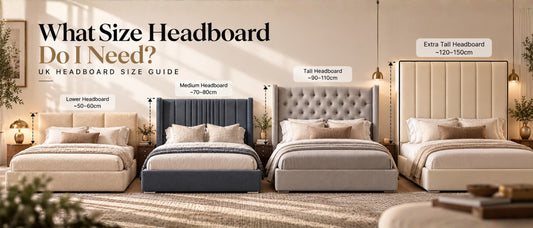
The old idea of a divan as a plain base with a separate headboard doesn't really hold any more. Both types now come upholstered, with tall statement headboards in velvet, boucle and linen-look fabrics.

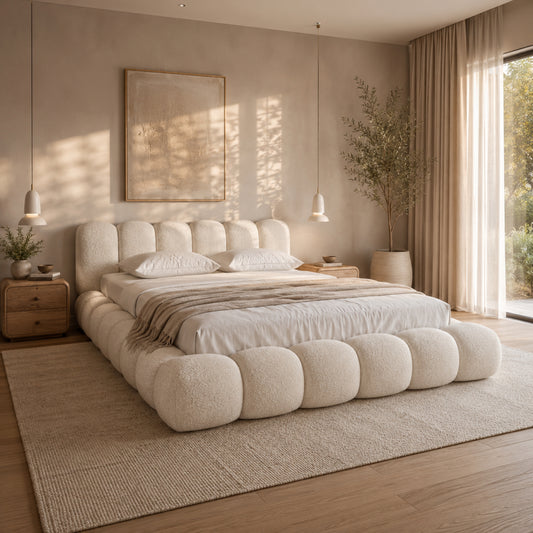
The difference you'll notice is at the base. An ottoman has smooth, unbroken sides, because the storage is hidden inside. A divan has drawer fronts along the side. Some people like that tailored-furniture look, while others would rather have a clean line.
Moving House or Rearranging
Ottomans are heavier because of the lifting platform and mechanism. Moving one usually means taking it apart. A divan base is often easier to shift between rooms, though a large one will still need two people.
If you rent, or expect to move in the next year or two, bear that in mind.
So Which Should You Choose? A Quick Test
Answer these three questions honestly:
- What's the biggest thing you want to store under the bed? If it's a suitcase, a duvet or anything bulky, choose an ottoman. If it's clothes, linen or small items, either will do.
- How often will you need it? If it's most days, lean towards a divan. If it's now and then, lean towards an ottoman.
- Where's your spare space? If there's floor space beside the bed, a divan works. If the bed will be hemmed in by walls or furniture, an ottoman works better.
If you get two or more answers pointing the same way, you have your answer.
Frequently Asked Questions
Are ottoman beds better than divan beds?
Neither is better in every case. Ottomans store more and suit tight rooms and bulky items. Divans give faster access to smaller things and are usually cheaper.
Which holds more, an ottoman or a divan?
An ottoman, by some distance. It uses one open space under the whole mattress, while a divan's storage is split into drawers with a frame between them.
Is an ottoman or a divan better for a small bedroom?
Usually an ottoman. It doesn't need floor space beside the bed for drawers, so it can sit against walls on both sides. Just check you have room above it and at the lifting end.
Can I use any mattress on an ottoman or divan?
Almost any standard UK mattress works on either. With an ottoman, it's worth checking the mattress weight, because a very heavy one makes the base harder to lift.
Do ottoman beds break easily?
Not when they're built and used properly. The gas struts are the part that wears, and they're cheap to replace. See our ottoman bed problems guide for signs of wear and how to fix them.
Can I get a divan or ottoman bed in a small double?
Yes. Both styles come in every standard UK size, from 3ft single to 6ft super king. Browse by size from our 4ft small double beds upwards.
Still not sure? Send us a photo of your room and its measurements through our contact page, and we'll tell you which one we'd put in it.
Tags:
Previous
What Is an Ottoman Bed? The Complete UK Buyer's Guide
Next
Wingback Beds vs Panel Beds: Which Is Right for Your Bedroom? (2026 Guide)