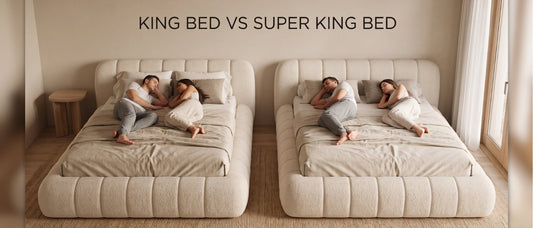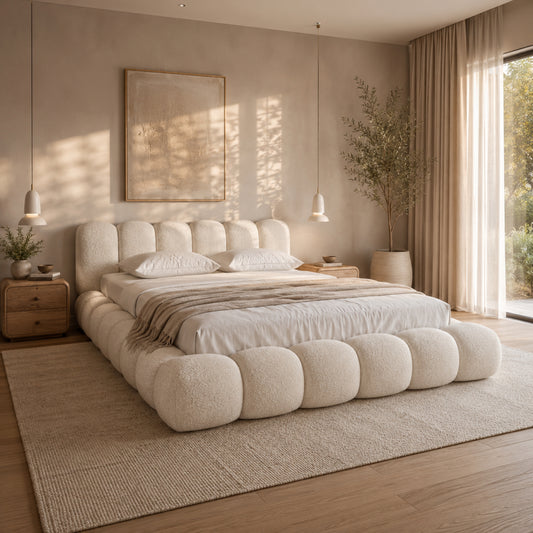
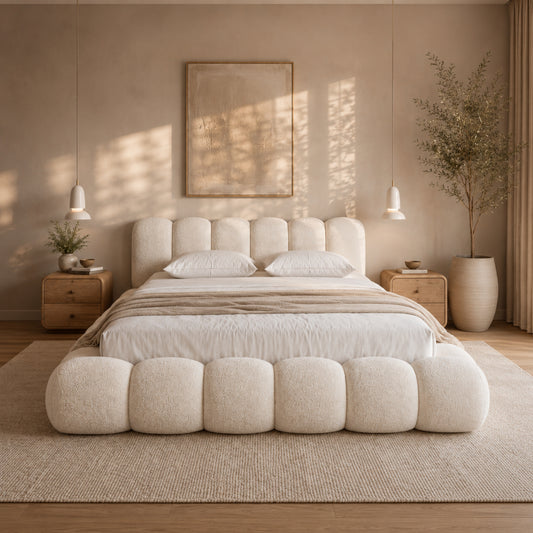
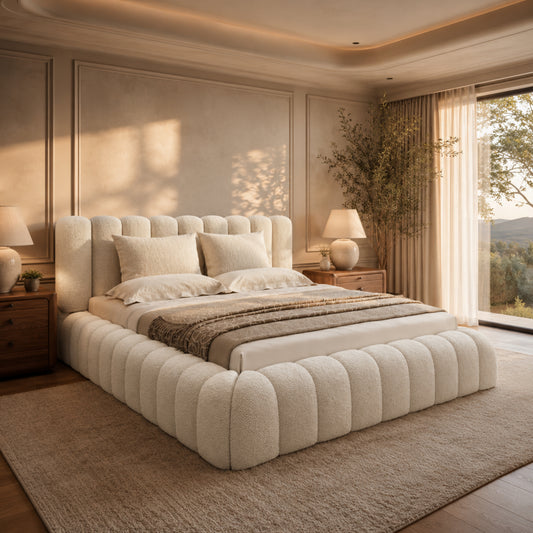
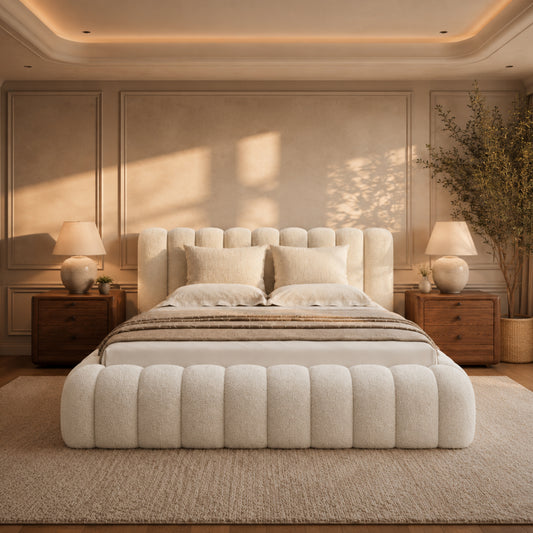
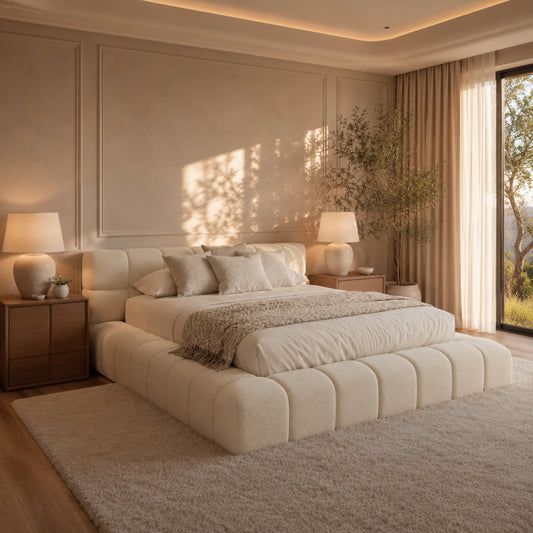
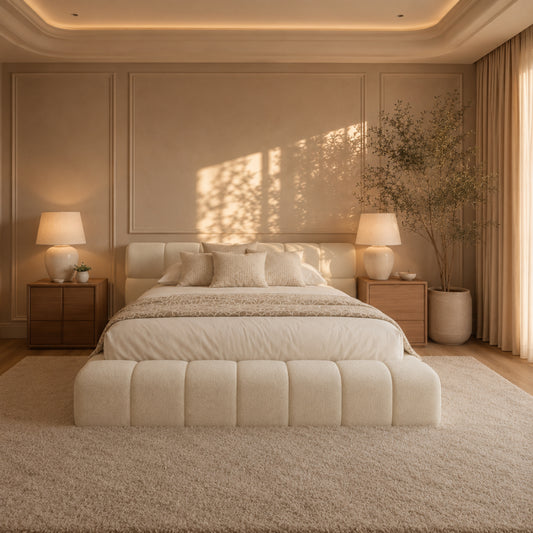

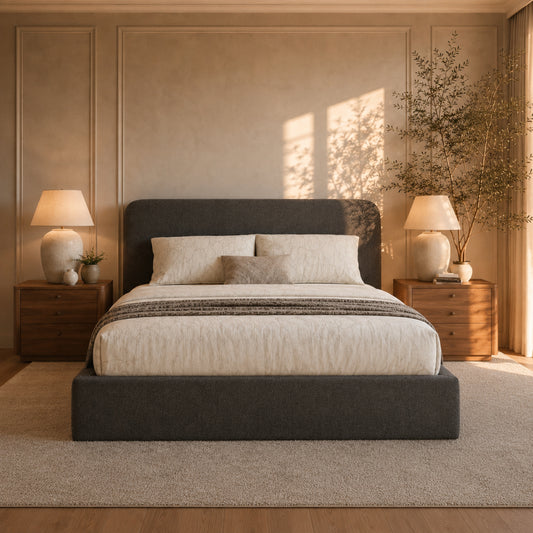

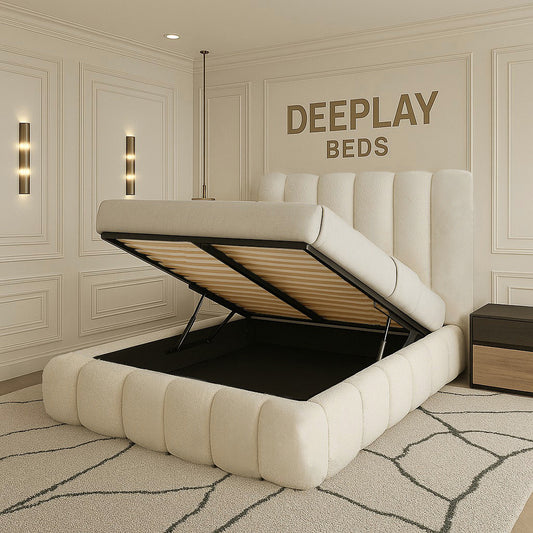

Choose an end-lift ottoman if you have clear floor space at the foot of the bed. Choose a side-lift ottoman if the foot of the bed is tight but one long side is free, which is common with single beds pushed against a wall.
Both give you the same thing in the end: the whole area under the mattress as storage. The difference is where you stand to open it, and that comes down to your room layout. Get it right and the bed is easy to use every day. Get it wrong and you end up dragging the bed out or squeezing past furniture each time you need the spare duvet.
This guide explains how each type opens, how much space each one needs, and how to measure your room before you order an ottoman bed.
How each one opens
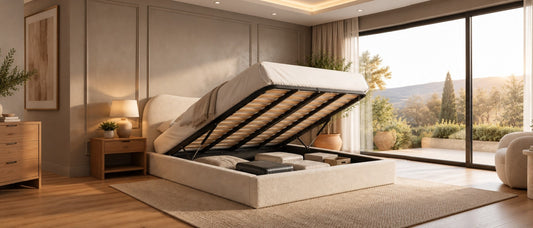
Every ottoman bed works the same way underneath. The mattress sits on a platform, and two gas struts take its weight so the platform rises and stays open without you holding it. What changes is where the hinge sits.
End-lift (foot-end) ottoman: The hinge runs across the headboard end. You stand at the foot of the bed, lift, and the platform tilts up towards the headboard, mattress and all. It is the most common type on doubles, kings and super kings.
Side-lift ottoman: The hinge runs along one long side of the bed. You stand at the other side, lift, and the platform tilts up towards the wall. Side-lift is usually found on singles and small doubles, because a narrower platform is easier to raise sideways.
In both cases, the gas struts are matched to the weight of a typical mattress. If a lift ever feels too stiff or won't stay open, our post on ottoman bed problems explains why.
Side-lift vs end-lift at a glance
|
|
End-lift |
Side-lift |
|
Where you open it |
From the foot of the bed |
From one long side |
|
Space you need clear |
At the foot end |
Along the opening side |
|
Bed against a wall |
Fine, the sides can be close to walls or bedside tables |
Fine, as long as the hinge side is against the wall |
|
Most common sizes |
Double, King, Super King |
Single, Small Double |
|
Reaching the far end of the storage |
The headboard end is a longer reach |
You can reach the whole length from one side |
|
Works well in |
Main bedrooms with bedside tables either side |
Box rooms, kids' rooms, guest rooms, narrow rooms |
Neither type holds more than the other. The storage space is set by the size of the bed, not the hinge.
When an end-lift ottoman is the better choice
An end-lift suits most main bedrooms, where the headboard sits against the wall and there is a walkway at the foot of the bed.
Pick end-lift if:
- You have bedside tables on both sides. The sides of the bed never move, so lamps, tables and chargers can stay where they are.
- You are buying a Double, King or Super King. End-lift is the standard set-up on larger beds, and you will have more styles to choose from.
- There is a clear walkway at the foot. You need room to stand there and lift, with nothing in the way such as a chest of drawers, a radiator or a TV unit.
- You want a footboard-free look or a low foot end. A tall footboard can get in the way of your hands when you lift, so check the design if you prefer one.
One thing to know: on a long bed, the storage at the headboard end is the hardest to reach. Keep things you use less often, like suitcases or winter clothes, at the top, and everyday spares nearer the foot.
When a side-lift ottoman is the better choice
A side-lift is made for smaller rooms, where the bed runs along a wall and the foot end is close to a door, wardrobe or another wall.
Pick side-lift if:
- The foot of the bed is blocked. In many box rooms the door swings in right by the foot of the bed. A side-lift means you never need that space.
- The bed sits lengthways against a wall. Put the hinge side to the wall and open from the room side. This is the usual layout for single beds and small doubles.
- It is a child's room. Children can reach the whole length of the storage from one side without climbing on the bed. Toys and spare bedding go in, and the floor stays clear. See our kids beds.
- It is a guest room. Visitors can get to spare pillows and towels without moving furniture.
- Things to check before you choose side-lift:
- Decide which side opens before you order. Once the bed is in place, the hinge side should face the wall.
- Keep the opening side clear of tall items. A bedside lamp next to the opening edge can get knocked as the platform rises.
- A side-lift is harder to use if both long sides are free and you want bedside tables on each. In that case, an end-lift is usually easier.
How to measure your room for the lift
A tape measure and five minutes will tell you which type fits. Measure the full frame size from the product page, not just the mattress, because upholstered sides and headboards add to the footprint. Our guide on how to measure your bedroom for a bed covers the basics.
Then check the lift itself:
- Mark where the bed will go. Use masking tape on the floor to show the outline of the frame.
- Find your standing spot. For end-lift, that is the foot end. For side-lift, it is the long side away from the wall. We suggest at least 60 cm of clear floor there, so you can stand and lift in comfort.
- Look up. As the platform rises, the mattress goes with it. Check for sloped ceilings, low shelves, wall lights and window sills on the side that lifts.
- Check the radiators. A radiator under the opening edge can get in the way of your legs, and a mattress resting against a hot radiator is never a good idea.
- Check your mattress depth. A very deep mattress can press against the headboard as the platform tilts. Mattresses up to about 32 cm deep suit most ottoman frames.
On every Deeplay product page, the dimensions image shows the full frame size. If the opening direction isn't clear for the model you like, ask us before you order. Call 07467 030468 or email info@deeplaybeds.co.uk and we will confirm it.
Frequently Asked Questions
Which is better, side-lift or end-lift?
Neither is better on its own. End-lift suits rooms with space at the foot of the bed. Side-lift suits rooms where the bed runs along a wall and the foot end is tight.
Does a side-lift ottoman hold less than an end-lift?
No. Storage space depends on the bed size, not the direction it opens. A Single holds the same whichever way it lifts.
Can I put a side-lift ottoman in the middle of the room?
Yes, but one side will be the hinge side and can't be opened. Keep a clear walkway on the opening side, and think about where your bedside tables will go.
Can I change which side a side-lift opens from?
This depends on the frame, and on most beds it is set when the bed is made. Some manufacturers offer reversible side-lift frames, while others have a fixed opening direction. Always check the product specifications before ordering.
Is an end-lift ottoman hard to open?
No. The gas struts take most of the weight of the mattress, so you only need a gentle lift. If it ever feels heavy or won't stay up, the struts may not suit your mattress weight. See ottoman bed problems for fixes.
Is an ottoman better than a divan with drawers?
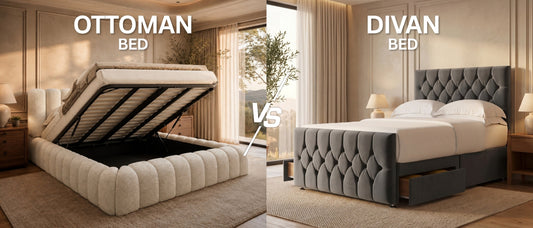
It depends on how often you need what you store. Drawers are quicker for daily items, while an ottoman holds more. Our ottoman vs divan guide compares the two in detail.
Ready to choose? Browse our ottoman beds in every UK size from Single to Super King, in panelled, wingback, Chesterfield and bubble styles.
Tags: